Celestial Blueprints: Sacred Site Alignments
Ancient temples and monuments worldwide share precise astronomical alignments that reveal a sophisticated understanding of celestial mechanics and Earth's geometry.
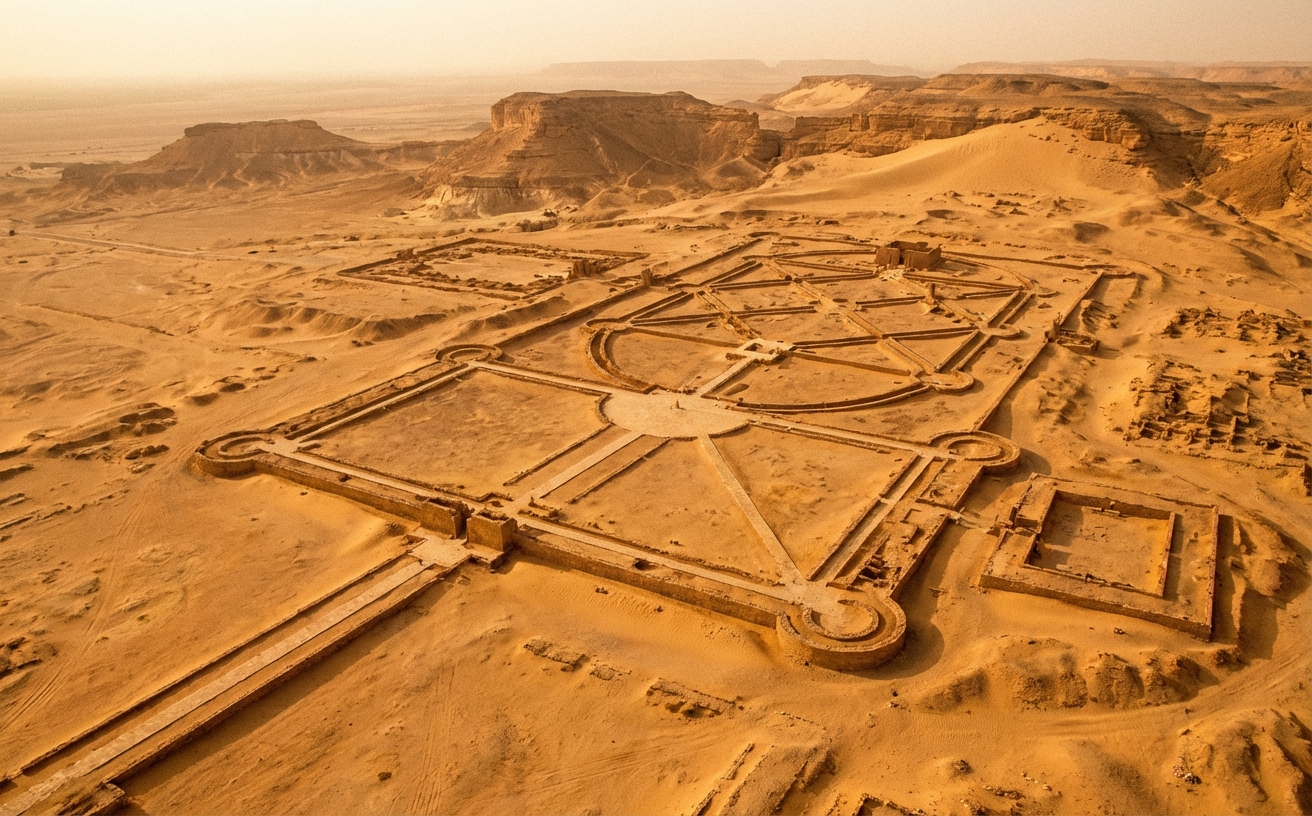
When viewed from above, the world's most ancient sacred sites reveal something remarkable: they are not randomly placed. From the pyramids of Giza to the temples of Angkor Wat, these structures follow geometric and astronomical patterns that span the entire globe.
The Orion Correlation
The three pyramids of Giza mirror the three stars of Orion's Belt — not as they appeared in 2500 BCE, but as they appeared around 10,500 BCE. This correlation, first proposed by Robert Bauval, suggests the site's layout encodes astronomical knowledge far older than the structures themselves.
When you plot the major sacred sites on a globe, they fall along great circle routes with a precision that cannot be attributed to coincidence.
A Worldwide Grid
Angkor Wat, Nazca, Easter Island, Giza, and dozens of other ancient sites lie along paths that divide the Earth's surface with geometric regularity. The distances between them encode mathematical constants — pi, phi, and the dimensions of the Earth itself.
Implications for Ancient Knowledge
These alignments suggest that ancient civilizations possessed a unified understanding of Earth's geometry and its relationship to the cosmos — knowledge that was encoded in stone to survive the ages.