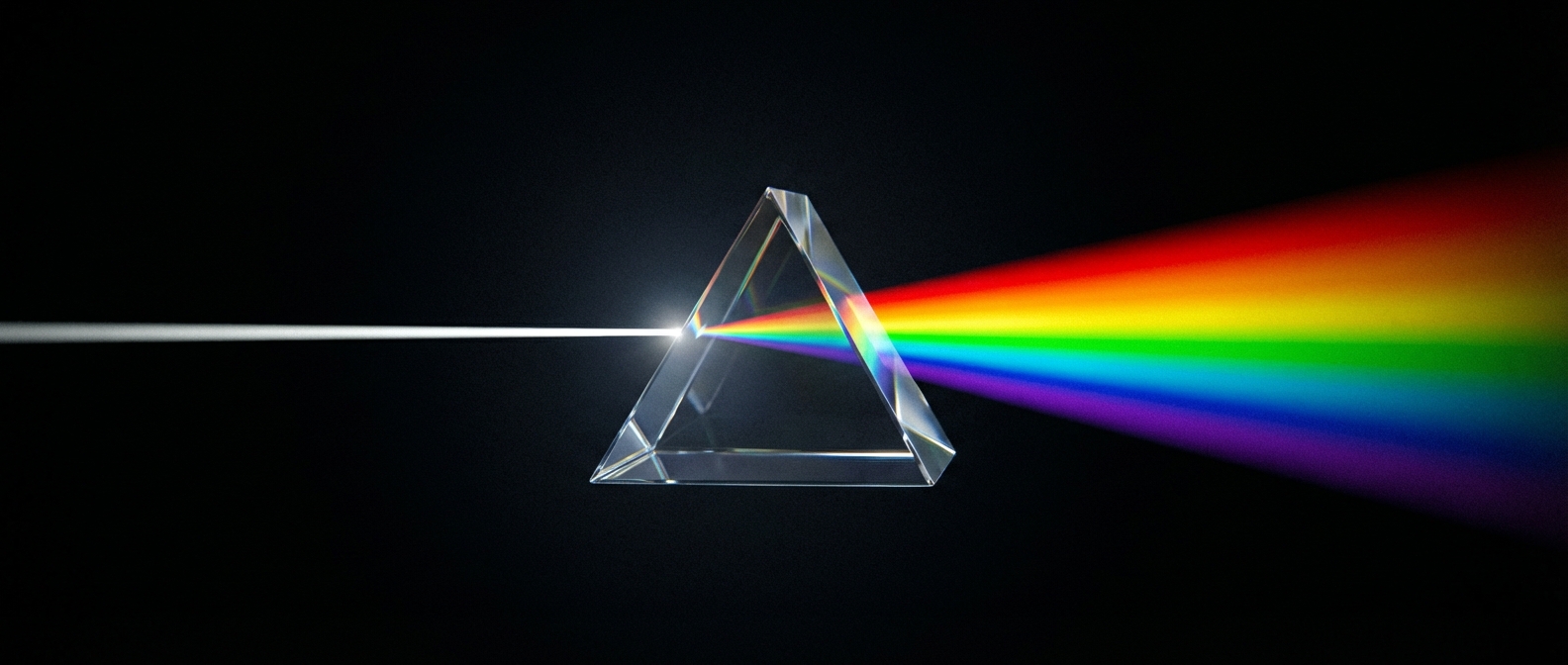
The Number That Stands at the Gate
Every electromagnetic interaction in the universe is governed by a single constant — 1/137. It is the boundary where the scalar field first permits light, charge, and matter. And it has a shape.
Every great physicist of the twentieth century obsessed over a single number — and none could explain it
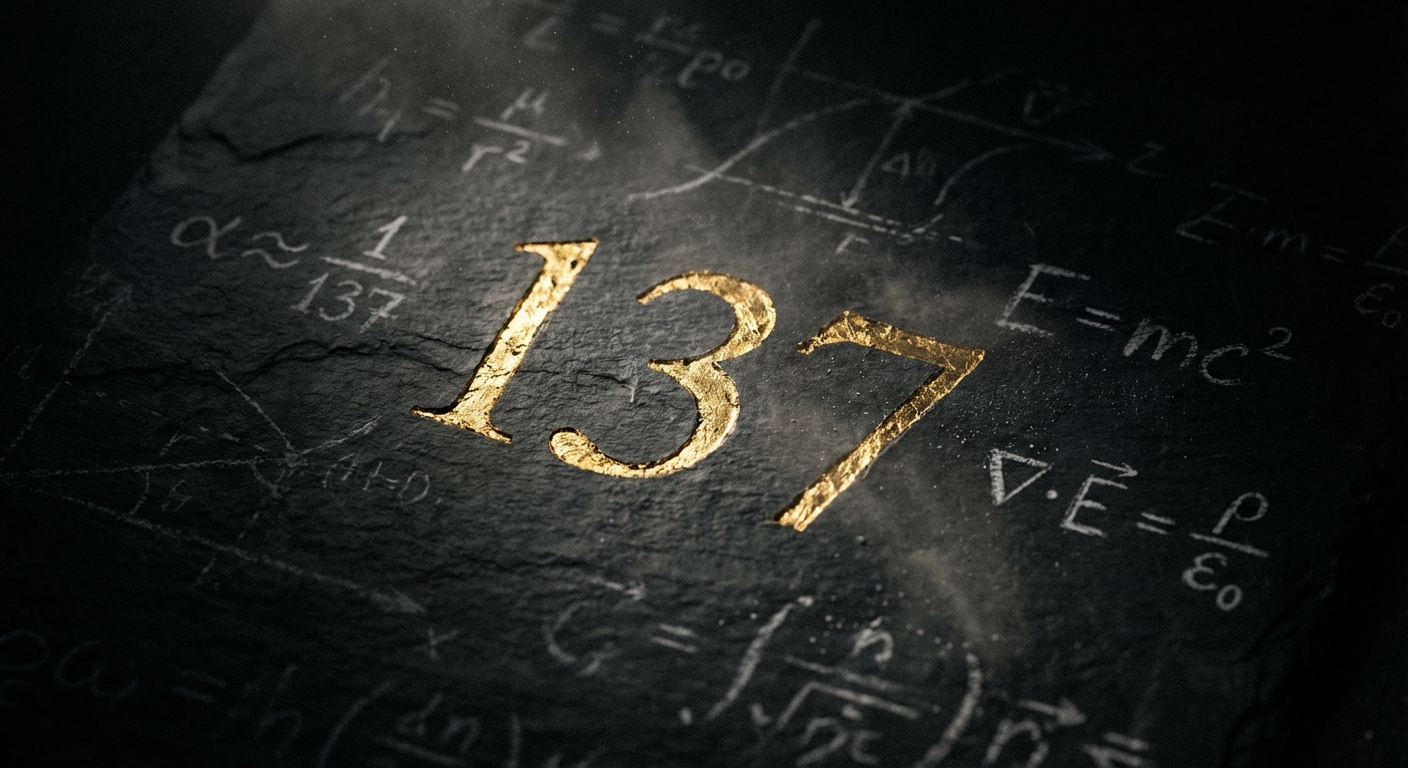
You encounter it the moment you ask how strongly light grips matter. The fine structure constant — approximately 1/137 — determines the strength of every electromagnetic interaction in the universe. How tightly electrons bind to nuclei. How light couples to charge. How atoms hold together and how chemistry works at all. Remove this single ratio and nothing you see would keep its shape.
Richard Feynman called it a mystery "all good theoretical physicists put on their wall and worry about." Max Born named it the most fundamental number in all of physics. Wolfgang Pauli pursued it for decades and died — in hospital room 137 — without explaining it. For a century, the number has sat at the foundation of the physical world. And no one could say why it takes this value.
A second constant marks the exact breath-point where every wave cycle turns
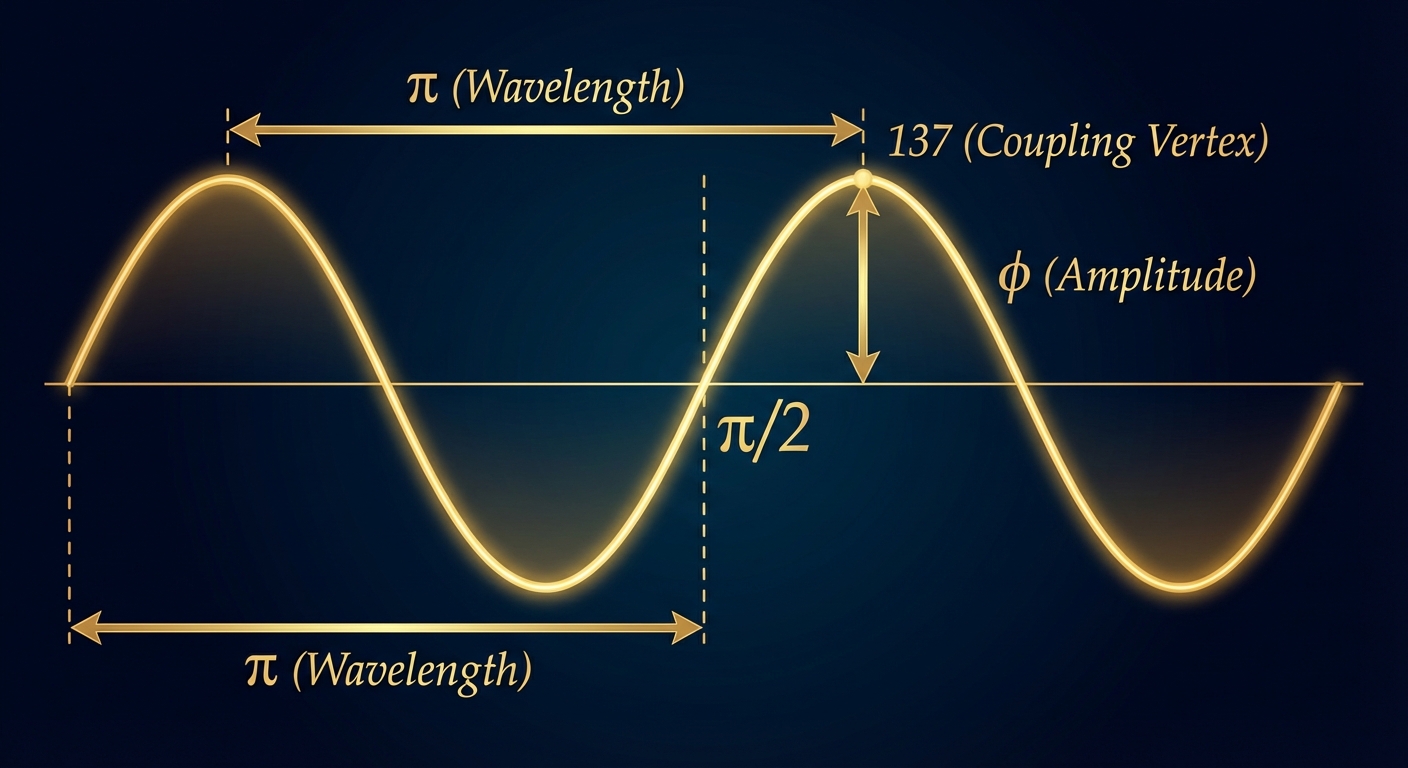
There is a point in every wave cycle where amplitude is zero but velocity is maximum. That point is pi/2 — approximately 1.57 — the quarter turn. Here the sine wave crosses its baseline at the steepest possible slope. It is the threshold between expansion and contraction, the instant where one phase hands off to the next.
Every oscillating system passes through this hinge. The heartbeat. The electron orbit. The stellar pulsation. Pi/2 does not create the wave — it marks where the wave breathes. Where contraction becomes expansion and expansion becomes contraction. The gate swings both ways, and pi/2 is the hinge.
Together, Alpha and Omega bound the entire cycle of manifestation — from first light to last breath
In the manuscript's framework, 137 is the membrane where non-local becomes local — the boundary condition between the scalar field and electromagnetic expression. Everything below that threshold belongs to the field. Everything above it belongs to the world you can measure: light, charge, interaction.
Pi/2 operates at a different scale. It does not set a boundary between domains. It marks the transition point within every cycle — the moment of maximum change, the breath between states. Ancient mystery schools encoded 137 in architecture and ritual, recognizing it as a threshold long before physics gave it a name.
Together they form a pair: Alpha marks where form first appears. Omega marks where each cycle completes and renews. The beginning and end of manifestation — the constants that bound how the scalar field interfaces with the material world.
Robert Edward Grant discovered that 137 has a geometric body — the Alphahedron

For a century, physicists treated 137 as a dimensionless ratio — a number without a body. Robert Edward Grant broke that assumption. He identified a novel geometric solid whose interior angle measures precisely 137.036 degrees and named it the alphahedron.
The solid has 26 vertices — matching iron, element 26, the heaviest element that stellar fusion can produce before the process consumes more energy than it releases. It is constructed from the 5-12-13 Pythagorean triple, the same harmonic mathematics that governs musical intervals and recurs throughout sacred geometry.
The question is no longer why this number. The question is what shape this number makes — and why that shape maps to the boundary of stellar matter.
When all elements are projected through Pythagorean geometry, they collapse into one shape — the Alphahedron

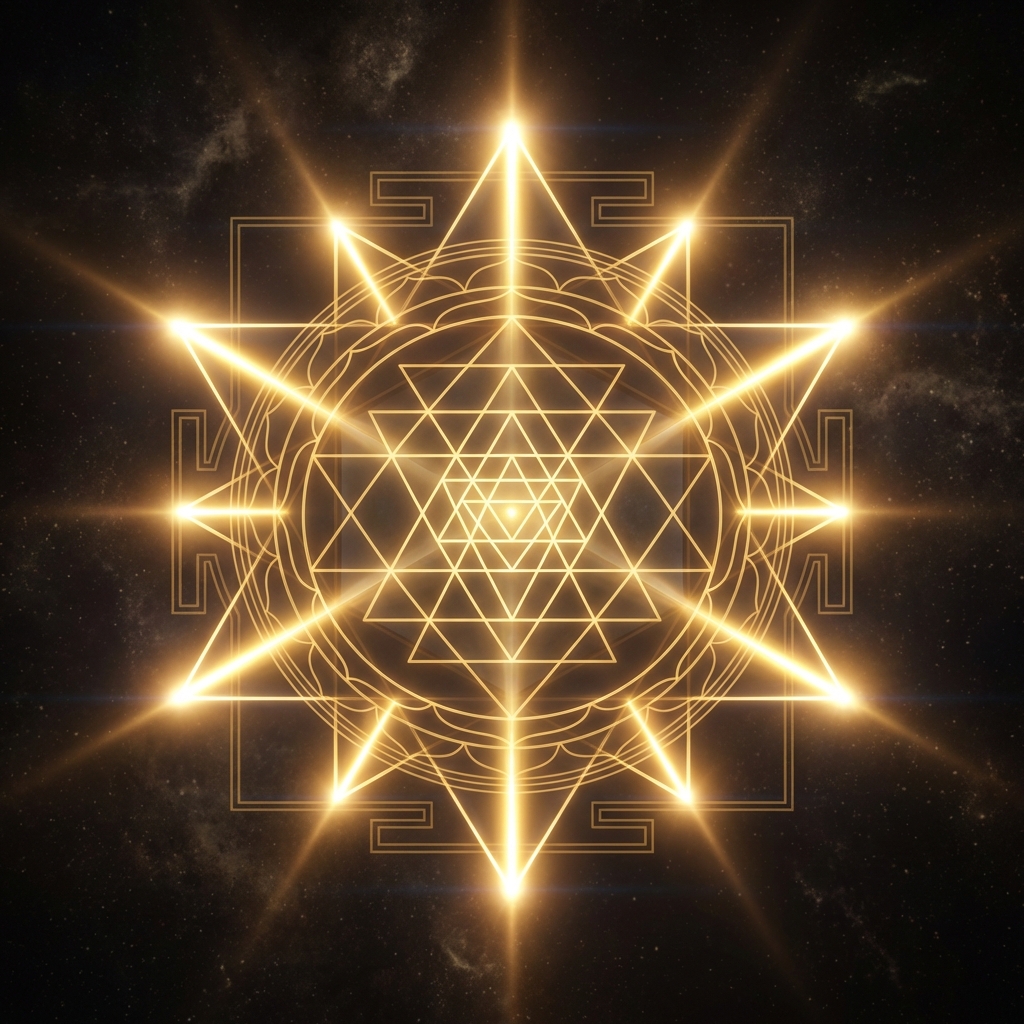
When all periodic elements are analyzed through their Pythagorean projections, they fragment into a single meta-shape: the alphahedron. The geometry that defines how strongly light couples to charge also maps to the element where stellar fusion reaches its thermodynamic limit. One shape governs both boundaries.
The alphahedron has two faces. Its convex form points inward — matter contracting, coherence holding, stability maintained. This is the gravitational aspect. Its stellated form radiates outward — points extending past the original boundary, edges pushing into space. This is the radiative aspect. The stellated form bears a striking resemblance to the Sri Yantra, the ancient mandala of interlocking triangles, and contains an eye-like form at its center — contraction and expansion meeting at a single focal point.
137 is the shape at which the scalar field first permits electromagnetic expression
Pi sets the wave's rhythm. Phi determines where that wave locks into stable form. And 137 governs how that form first interacts with light and charge. Pi/2 marks every transition between them.
The alphahedron reframes the fine structure constant from abstract ratio to geometric threshold. It is not merely a number governing interaction strength — it is the specific shape where the scalar field's potential first expresses as electromagnetic reality.
Constants are not empirical accidents scattered across equations. They are geometric necessities — interlocking constraints that together define the conditions under which form, light, and matter emerge.
The mystery is not solved. It is deepened. The question shifts from "why this number?" to "why this geometry?" And geometry, unlike a bare number, can be answered. Ancient traditions encoded what physics is only now rediscovering: 137 is not a curiosity at the margins of theory. It is the architectural gateway between field and world.
Next: The System Behind the Constants